Table of Contents
1.The Dream of an Indoor Spa vs. The Damp Reality
2.Understanding the Enemy: Why Humidity Is Your Biggest Challenge
3.Your Best Defense: Choosing and Sizing the Right Exhaust Fan
4.Mastering the Install: Fan Placement and Ducting Best Practices
5.Conclusion: Enjoy Your Indoor Oasis, Worry-Free
1.The Dream of an Indoor Spa vs. The Damp Reality
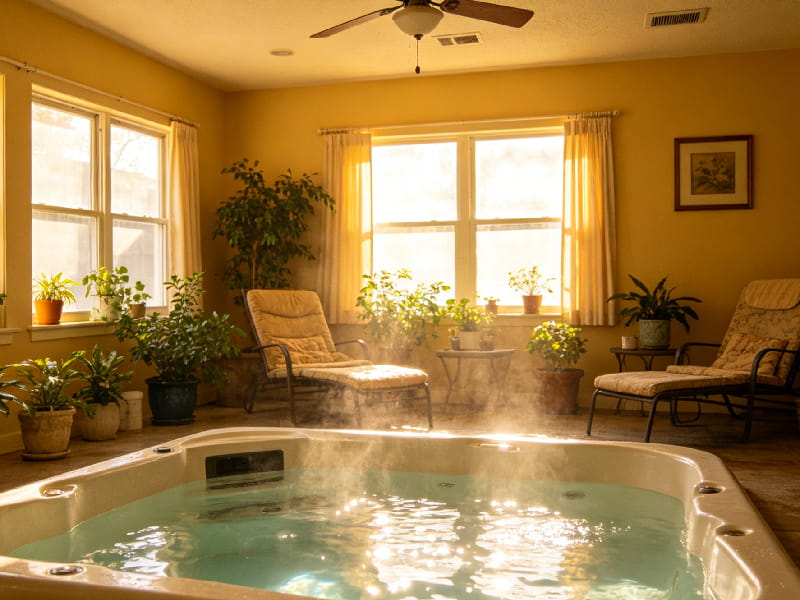
Imagine this: a perfect, private retreat right inside your own home. No matter the weather outside, your personal hot tub is just steps away, ready to melt your stress away. This is the dream of installing a hot tub inside. It offers unparalleled convenience, privacy, and year-round enjoyment.
But this dream can quickly turn into a damp, musty nightmare if one critical element is overlooked: ventilation.
A hot tub is essentially a beautiful, large-scale humidifier. Every time you lift the cover, steam billows out, filling the room with warm, moist air. Without a way to manage this moisture, you're creating the perfect breeding ground for mold and mildew. This can lead to peeling paint, warped wood, a persistent musty odor, and even structural damage to your home .
The good news? All of this is completely preventable. Proper indoor hot tub ventilation isn't just a recommendation; it's the cornerstone of a successful and long-lasting indoor spa room. This guide will walk you through everything you need to know about managing hot tub room humidity and creating a healthy, beautiful space for your oasis.

2.Understanding the Enemy: Why Humidity Is Your Biggest Challenge
Before we talk about solutions, let's understand the problem. The key metric here is Relative Humidity (RH), which measures the amount of moisture in the air compared to the maximum amount it can hold at a specific temperature. For a spa room, you need to find the "Goldilocks Zone" – not too dry, and definitely not too damp.
l The Danger Zone (Above 60% RH): This is where problems begin. Mold and mildew spores, which are always present in the air, find a perfect home on damp surfaces and begin to multiply rapidly . You'll start to notice that "damp basement" smell, and visible spots may appear on walls and ceilings.
l The Safe Zone (30% - 50% RH): This is your target. In this range, mold growth is effectively halted . Maintaining your spa room within this humidity level protects your investment, your home's structure, and your family's health.
Controlling humidity is the single most important step in preventing mold. A powerful, correctly installed exhaust fan is your number one tool to keep the RH in that safe zone.
3.Your Best Defense: Choosing and Sizing the Right Exhaust Fan
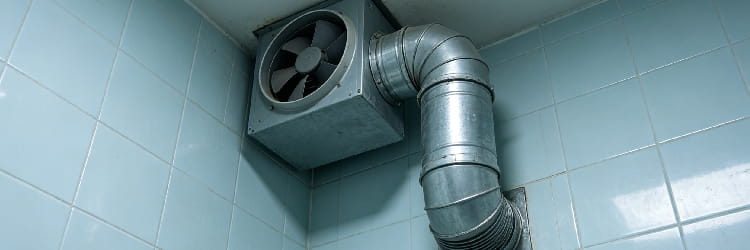
Not all fans are created equal. To tackle the immense amount of moisture a hot tub produces, you need an exhaust fan with the right power, measured in CFM (Cubic Feet per Minute). This rating tells you how many cubic feet of air the fan can move in one minute . A higher CFM means a more powerful fan.
So, how much CFM do you need? There are two common ways to calculate this, but for a high-moisture environment like a spa room, one method is far superior.
Method 1: The Basic Area Formula (For Small, Simple Bathrooms)
For standard bathrooms under 100 square feet, a simple rule is 1 CFM per square foot of floor space . For an 8'x10' bathroom (80 sq ft), you would need an 80 CFM fan.
This method is NOT recommended for a room with a hot tub, as it significantly underestimates the moisture load.
Method 2: The Fixture-Based Formula (The Right Choice for Spa Rooms)
For larger rooms (over 100 sq ft) or any room with major moisture sources, the Home Ventilating Institute recommends calculating CFM based on the fixtures in the room. This ensures you have enough power to handle the specific demands of your space .
Here’s how to calculate it:
1.List all the fixtures in your spa room.
2.Assign a CFM value to each one.
3.Add the values together for your total required CFM.
Use these standard values for your calculation:
Fixture | Recommended CFM |
Hot Tub / Spa / Jetted Tub | 100 CFM |
Shower | 50 CFM |
Bathtub (standard) | 50 CFM |
Toilet | 50 CFM |
Example Calculation:
Let's say your indoor spa room contains:
l One Hot Tub: 100 CFM
l One enclosed Shower: 50 CFM
l One Toilet: 50 CFM
Total Required CFM = 100 + 50 + 50 = 200 CFM
In this scenario, you should look for an exhaust fan rated for at least 200 CFM. When in doubt, it is always better to oversize your fan slightly than to undersize it. You can't have too much ventilation in a spa room.
Smart Features to Consider
l Humidistat Sensor: A fan with a built-in humidistat is a game-changer. It automatically turns the fan on when humidity rises above a preset level (e.g., 55%) and turns it off when the air is dry again . This is the ultimate "set it and forget it" solution for protecting your room.
l Timer Switch: A timer allows you to run the fan for a predetermined amount of time (e.g., 30-60 minutes) after you've finished using the spa . This ensures all the lingering moisture is cleared out of the room.

4.Mastering the Install: Fan Placement and Ducting Best Practices
Buying the right fan is only half the battle. A powerful fan installed poorly will not be effective. Proper placement and ducting are crucial for maximizing performance and ensuring moisture is actually removed from your home.
Placement is Key
l Locate it Near the Source: Install your exhaust fan on the ceiling as close to the hot tub as possible . This allows it to capture the steam and moist air right at the source before it has a chance to spread throughout the room.
l Consider the "Makeup Air": For a fan to push air out, new air ("makeup air") needs to come in. This air will typically enter from the gap under the door. For best results, place your fan on the opposite side of the room from the door. This creates a cross-breeze that pulls fresh, dry air across the entire room, improving circulation and moisture removal .
Ducting Done Right
The duct is the pathway that carries the moist air from the fan to the outside. Mistakes here can render your fan useless.
l VENT TO THE OUTSIDE. ALWAYS. This is the most important rule. Never, ever vent a spa room fan into an attic, crawlspace, or wall cavity . Doing so simply moves the moisture problem to a different part of your house, leading to hidden mold and rot. The duct must terminate completely outside your home.
l Keep Ducts Short and Straight: The longer the duct and the more bends it has, the harder the fan has to work . This friction reduces the fan's effective CFM. For optimal performance, plan the shortest, straightest route from the fan to the exterior wall or roof.
l Use Rigid, Smooth Ducting: While flexible, ribbed ducting is easy to install, its rough surface creates air resistance and can trap moisture. Whenever possible, use rigid, smooth-walled metal ducting for the best possible airflow .
l Insulate Your Ductwork: If your ductwork runs through an unheated space like an attic, be sure to insulate it. This prevents the warm, moist air inside the duct from condensing when it hits the cold attic air, which can cause water to drip back down into your ceiling.

5.Enjoy Your Indoor Oasis, Worry-Free
Creating an indoor spa sanctuary is an exciting project. By focusing on proper ventilation from the very beginning, you protect your home, your health, and your investment for years to come.
Let's recap the keys to success:
l Control the Environment: Actively monitor and maintain the relative humidity in your spa room between 30% and 50% to eliminate the risk of mold.
l Get the Right Tool: Choose an exhaust fan with enough CFM power, using the fixture-based calculation for an accurate assessment (100 CFM for the hot tub, plus 50 CFM for any other major fixture).
l Install It Like a Pro: Position the fan near the hot tub and ensure the ductwork is short, straight, and vents directly to the outdoors.
By following this guidance on indoor hot tub ventilation, you can stop worrying about moisture and focus on what truly matters: enjoying every blissful, relaxing moment in your perfect indoor retreat.